- Key Takeaways
- Understanding Dashboard Light Colours
- Critical Red Dashboard Warning Lights
- Important Amber Dashboard Warnings
- Alberta’s Unique Dashboard Challenges
- Is It a Glitch or a Real Problem?
- Your Next Step: Professional Diagnostics
- Conclusion
- Frequently Asked Questions
- What do dashboard light colors mean?
- Which red warning lights need immediate action?
- Why do amber lights appear more in Alberta winters?
- Could gravel or rural driving trigger ABS or traction lights?
- Is my check engine light a glitch after refueling?
- Can extreme cold drain the battery and cause warnings?
- When should I seek professional diagnostics?
Key Takeaways
- Familiarize yourself with your dashboard lights color code and maintain a handy reference sheet in your glove box or phone for quick inspections. Red implies stop now, amber suggests book service soon, and green or blue indicates a feature is turned on.
- Consider red alerts as an urgency and pull over safely to avoid damages or breakdowns. Typical red alerts are oil pressure, engine temperature, brake system, charging system, and airbag malfunctions.
- Handle amber cautions immediately to shield efficiency and meet standards. Standard amber warnings are check engine, tire pressure, ABS, and stability control.
- Use green or blue when available to indicate information about active features. Check your owner’s manual and familiarize yourself with your vehicle’s particular symbols for lights like headlights, fog lights, and cruise control.
- Get ready for Alberta with pre-winter checks of your battery and TPMS, winter tires, and post-gravel road inspections of sensors and wiring. Fleet operators can record warning light events and respond promptly to comply with safety and regulatory requirements.
- If a light is a glitch, it will clear upon a single restart. Then scan with an OBD tool and note codes if it returns. Come to Hart Transmission and Mechanical in Alberta for professional diagnostics immediately. We can test and repair.
They’re dashboard warning lights, standardized icons on a vehicle’s instrument cluster that indicate system status and faults. They use color to show urgency: red for stop-now hazards, amber for service soon, and blue or green for normal features. Typical lights are check engine (powertrain), oil pressure, battery charge, coolant temperature, brake and ABS, tire pressure (TPMS), airbag, traction control, and stability control. A lot of symbols come on at start-up as a bulb check, then go off once systems pass. Certain alerts flash when the fault is active and remain solid when the system is deactivated. Symbols adhere to ISO and SAE standards, but wording differs by manufacturer. To separate dangers from ding dongs, the next bits dissect meanings, causes, and actions.
Understanding Dashboard Light Colours
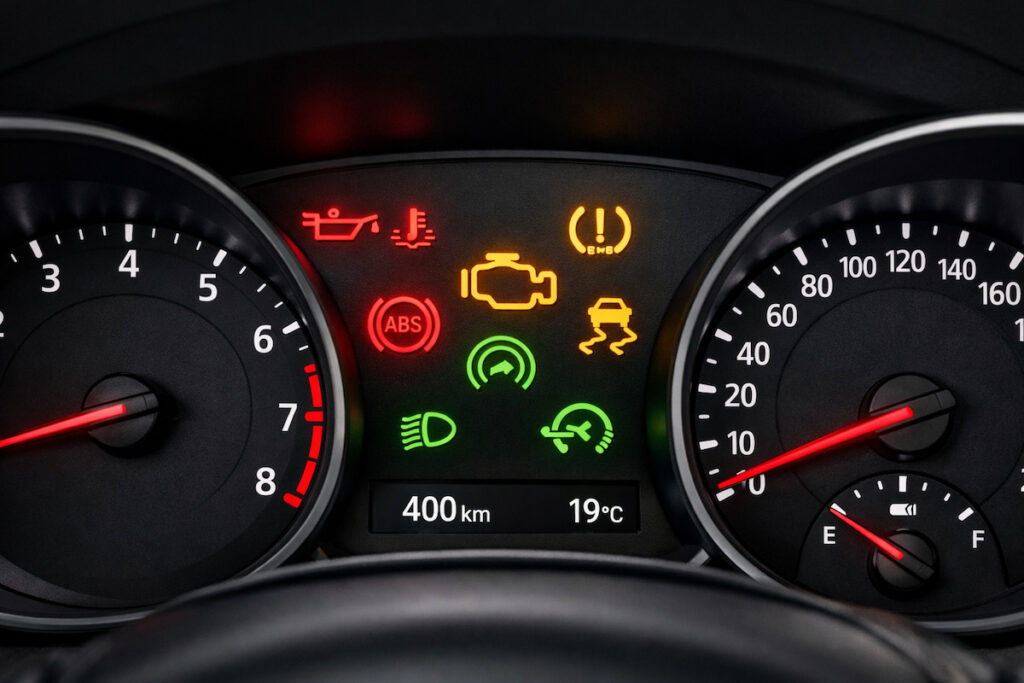
Dashboard lights use a simple color system to show severity at a glance: red for urgent problems, amber (yellow/orange) for issues that need timely attention, and green/blue for information about active features. Misinterpreting these colors can signify you overlook a vital caution, which endangers safety and might violate local road regulations in Canada, particularly in winter when breakdowns intensify rapidly.
- Red: Stop safely. Urgent action required; a serious fault or safety risk.
- Amber (yellow/orange): Check soon. Someone has to take a look at it before it deteriorates.
- Green/blue: Feature is on. No fault indicated.
Create a quick-reference cheat sheet in your glove box with the common colors, names, and rudimentary next steps for your particular vehicle. Update it as you add winter tires, change bulbs, or after service visits!
Misunderstanding colors results in skipped action and larger catastrophes. It can transform a minor repair into a tow or, worse, a road menace.
Red Alerts
Red lights indicate either immediate danger or a seriously malfunctioning system. Pull over securely, park, and turn off the engine if necessary.
Common red alerts include brakes (BRAKE light or brake system symbol), engine temperature, oil pressure, and airbag faults. A red battery indicates charging issues that may stall the car and disrupt power steering.
Keep driving on red alert and repairs can spike, brakes can fade and you can encounter high-speed hazards on the 400-series highways or back-country routes in winter.
Both weather and traffic are important. Heavy slush, steep grades, or stop-and-go can push coolant temperatures and set off a red overheat light.
Amber Cautions
Amber lights indicate a system requiring imminent care, not an emergency stop. Schedule an inspection before it becomes a bigger repair or compliance problem. Typical amber alerts are the check engine light (misfire, sensor, or emissions fault), tire pressure monitoring (cold snaps in Canada tend to drop kPa enough to trigger TPMS), stability or traction control warnings, and glow plug or DPF notices on diesels. Some lights are normal to be on at start-up and should go off after a few minutes. If an amber light stays on or comes back, then deal with it like a ‘real’ fault. Neglecting amber warnings can affect fuel economy, power, or cause emissions violations and failed readiness monitors.
Green/Blue Info
Green or blue lights are status indicators. They indicate engaged functions such as low-beam headlights, which are typically green, high beams, which are blue, fog lights, cruise control, lane-keeping ready, or trailer mode. Know your symbols to effectively employ auxiliary lamps in snow, rain, and early dusk typical of Canadian fall and winter. Consult your owner’s manual for your specific icon set because brands differ and updates alter symbols annually. Familiarizing yourself with the three basic types, red, amber, and green/blue, guides you to act quickly and cut out the guesswork.
Critical Red Dashboard Warning Lights
Red icons indicate STOP and solve NOW. Newer cars will couple these lights with chimes and a message in the cluster or center display. If a red light flashes or remains on, pull over to a safe place on the shoulder, a rest stop, or well-lighted lot. This is particularly crucial on Canadian highways during the winter. For fast roadside diagnostics, store a basic table of red lights and interpretations on your phone.
- Oil pressure (oil can): Low or lost oil pressure means a risk of engine damage.
- Engine temperature (thermometer): Overheating or coolant fault. Stop to prevent harm.
- Brake system (BRAKE or circle/exclamation): Fluid loss, pad wear, or failure risk.
- Charging/battery (battery icon): Alternator or wiring problem. Blinking above 30 km/h implies ZERO charge.
- Airbag/SRS (airbag symbol): Fault in restraint system, reduced crash protection.
- Power steering (steering wheel/exclamation): Assist failure. Steering may be heavy.
- Check engine: Often amber, but still critical. This can range from the gas cap to the catalytic converter.
1. Oil Pressure
A red oil pressure light indicates the engine lost pressure or dropped to a critical level. Bearings, cams, and turbochargers can run dry fast.
Turn off the engine immediately. Coasting to a safe stop trumps a seized motor any day. Turn it off until you discover what it is.
Driving on risks permanent damage and a bill that can top the car’s worth in Canada. Check the dipstick, peek under the car for drips, and inspect for a loose filter or cap.
If oil is low, only add the correct grade if you have it. Then, tow for diagnosis.
2. Engine Temperature
Critical Red Dashboard Warning Lights The red temperature light indicates an overheated engine or a coolant system failure. Pull over, shut it off, and let it cool. The phenomenon of ‘Opening a hot cap burns your face, wait’ Failed water pump, stuck thermostat, broken belt, leaking radiator or hose, and an electric fan that won’t run in stop-and-go on the Gardiner or during a -20°C cold snap after a long idle. Neglect this and you’ll fry heads, blow gaskets, and dump coolant. When safe, check the coolant level, look for white steam or a sweet smell, and check for neon stains on the splash pan.
3. Brake System
It could indicate low fluid, worn pads, a failed sensor, or a hydraulic fault.
First, ensure the parking brake isn’t engaged. Test pedal feel in a safe zone.
If the light remains on or the pedal sinks, pull over and schedule a tow. A full brake check is immediate.
4. Charging System
The battery light indicates alternator, battery, or cable problems that leech power to lights, fuel pump, and ignition. If it flashes above 30 km/h, the battery isn’t charging.
Turn off heated seats, rear defrost, and HVAC blower to stretch charge. Go have the alternator output and belt, battery health, and grounds checked.
5. Airbag Fault
If your airbag light stays on, it signifies that your SRS has an error and likely will not deploy in an accident.
This slices a vital safety layer and can deactivate connected emergency braking or steering assist in newer vehicles.
Schedule diagnostics soon. Typical issues include loose connectors under seats, clock spring faults, or crash sensors.
Don’t let it pass. You want complete coverage on the 401 or in downtown rush hour.
Important Amber Dashboard Warnings
Amber lights employ a color code to signify non-critical problems that require attention in the near future. They frequently indicate issues with emissions, traction control, or tire pressure. Red lights indicate a critical issue, so stop and inspect immediately. Dealing with amber warnings in a timely manner keeps emissions compliant and the vehicle running great, particularly with Canada’s weather, traffic, and road swings.
- Check engine (emissions/engine management)
- Tire pressure monitoring system (TPMS)
- ABS (anti‑lock braking system)
- Stability/traction control (ESC/TCS)
- Glow plug or DEF/DPF alerts on diesel vehicles
- Transmission or drivetrain warnings
- Adaptive lighting or sensor blockage (camera/radar)
Check Engine
The check engine light indicates it has found a trouble code with the engine or emissions system, from a loose gas cap to misfires, O2 sensor troubles or evaporative leaks. Start with an OBD scan tool to read DTCs, and while most parts stores and shops in Canada can pull codes, many drivers keep a Bluetooth OBD reader in the glovebox. Dismissing this light can increase emissions, reduce fuel economy, damage the catalytic converter, or mask problems that become more expensive over time. Get it checked out immediately, verify the fault with data (freeze-frame, live fuel trims), and address the cause, not clear the code.
Tire Pressure
A tire pressure light indicates that the TPMS detected pressure out of its range or lost contact with a sensor.
Inspect all four tires and the spare. Inflate to the door-jamb label, not the sidewall. Check for nails, cuts, or a bent rim. A puncture or a dead TPMS battery may trigger the light.
Temperature swings are significant for Alberta and the rest of Canada. Anticipate roughly a 1 to 2 PSI swing for every 10 degrees of change. A 4 PSI increase or decrease can activate the light. Winter cold snaps and hot summer highways bring more warnings.
Driving low on air diminishes grip, wears edges quickly, damages fuel economy, and increases blowout potential. Recheck pressures after an extended drive and prior to highway trips.
ABS Fault
ABS light indicates the anti-lock system or a wheel speed sensor has failed, so you still have standard braking but ABS modulation will not engage in a panic stop. This increases danger on wet pavement, slush, packed snow, or gravel and lane-change emergencies on congested arteries such as the Trans-Canada. Schedule a timely inspection to recover ABS capability and preserve highway safety buffers.
Stability Control
A stability control warning indicates a malfunction in traction control or automatic emergency steering assistance. This can deactivate ESC and TCS.
Go easy on the wheel. Give yourself more room, ease into corners, and avoid sudden throttle.
Disregarding the light increases the danger of spinning or sliding on ice-covered ramps, loose gravel, or even during aggressive driving on dry tarmac.
Get a shop to run diagnostics, check yaw and steering angle sensors, wheel speed inputs, and alignment so full traction and stability control come back online.
Alberta’s Unique Dashboard Challenges
Alberta’s cold snaps, dry air, highway stretches and rough rural roads produce very specific hazards that cause the dash to light up more frequently and for different causes than in more temperate climates. Spotting winter, gravel and fleet alerts early slashes downtime and expense, particularly for trucks and high-mileage motorists.
Checklist: warning lights commonly affected in Alberta
- Battery/charging, glow plug (diesel), and cold-start indicators
- Tire Pressure Monitoring System (TPMS)
- Traction control, stability control, and ABS
- Collision avoidance and front radar/camera alerts (after wildlife encounters)
- Washer fluid and windshield sensor faults
- Airbag/SRS
- Low fuel and range warnings
Cold Weather
Extreme cold leeches batteries and decelerates chemical reactions, so battery and charging lights appear more on -30°C mornings. Diesel glow plug lights can remain illuminated longer, indicating faulty plugs or relays. TPMS warnings jump when the temperature falls because tire pressure decreases by approximately 7 kPa for every 5°C change.
Do a pre-winter check: load test the battery, inspect block heater cords, clean sensor connectors, and confirm TPMS readings match a gauge. Fill up with winter-grade washer fluid. Alberta’s dry air can freeze or clog lines and set off a washer or camera-cleaning warning.
Cold can kick up false flags. Glitchy wheel speed sensors can flash ABS or traction lights until the car comes up to temp. If a light clears after a short drive, record it, then pull codes if it returns.
Use legit winter tires and have every warning bulb and icon working before the first cold snap. Nelson dim or dead indicators mask true failures when you crave traction.
Rough Roads

Gravel and washboards shake wiring, crack sensor pigtails and rattle bulbs which causes brake, ABS or airbag lights to flicker on. After off-pavement adventures, inspect wheel speed sensors for stone strikes, check pad thickness and lines, and verify all exterior lamps. Dust can obscure radar or cameras and trigger collision system false alerts, common after wildlife close calls on Highway 2 or rural range roads. Vibration loosens grounds, causing on-off warnings tied to bumps. If a new rattle, pull or light pops up following a cutline or lease road, plan a fast scan and a harness inspection around hubs and skid plates.
Fleet Compliance
Alberta’s unique dashboard challenges — incorporate daily indicator checks into your pre-trip inspections, log each occurrence with date, code and fix, and establish immediate repair limits, particularly for ABS, airbag and stability faults.
Unresolved lights can flunk CV inspections or spark fines and they increase collision and downtime risk in winter peaks.
| Warning Light | Safety/Regulatory Link | Required Fleet Action |
|---|---|---|
| ABS/Brake | Stopping performance, CVIP item | Immediate diagnosis, document repair |
| Airbag/SRS | Occupant protection | Remove from service until fixed |
| ESC/Traction | Stability on ice/gravel | Priority repair, driver advisory |
| Check Engine (emissions) | Emissions compliance | Scan, fix, clear, keep records |
| TPMS | Tire safety, fuel use | Inflate, inspect, record baseline |
| Collision System | Forward detection integrity | Clean sensors; repair if faulted |
Is It a Glitch or a Real Problem?
Dashboards flag faults, but not every alert signals a failing part. A few lights will clear automatically when a sensor hiccups. Others cite problems that can escalate, particularly with electrical defects. Differentiate a short glitch from a recurring pattern and record what you observe so a technician can identify the source.
The Restart Trick
Turn it off, wait a moment, and turn it back on. A clean restart can clear minor alerts associated with temporary sensor readings or low voltage at startup. If it remains off after one drive cycle, it may have self-cleared. Don’t rely on this for red alerts such as oil pressure or overheating, or for amber cautions that keep popping up. Those require diagnosis, not resets. If lights flicker, that typically links to the alternator, a weak battery, or a more serious electrical issue a reboot won’t solve. Flickering in the dark can impair your vision of the road when spokes pull more juice.
If the warning returns, record the time, speed, weather, headlights, and any unusual patterns or odors. That record comes in handy later.
Sensor Issues
Defective sensors or loose wires can flicker warning lamps. Watch for patterns: a warning after a hard bump could hint at a loose connector. One that surfaces in slush or pounding rain may suggest moisture in a plug or corroded pins, courtesy of those Canadian salted winter roads.
Inspect exposed harnesses and connectors in the vicinity of the battery, wheel wells, and underbody shields. Check for rubbed insulation, green or white crust on terminals, or cracked clips. Sometimes, fixing a bad ground or cleaning a connector can stop random alerts.
Some lights behave normally in context, like a 4WD light when you put it in 4H on a snow-covered street. Flickering cluster lights are another beast. They might be indicating charging problems, a dying battery or failing alternator. You might experience hard starts, stalls, a growl or whine, or a hot rubber smell from a slipping belt. Even if flicker ceases, it still warrants a look.
When to Scan
If a warning remains following a single restart, scan the vehicle with an OBD tool. Write down the codes and freeze-frame data, along with your notes on when the light illuminated. Scanning distinguishes minor faults, like an EVAP leak code from a loose gas cap, from critical ones, such as misfires that can damage the catalytic converter or charging-system faults that cause flicker. Most consumer tools will display live voltage, and low system voltage under load indicates either the alternator or battery. Use the scan as a pre-booking service so you can communicate codes and symptoms and schedule the fix. Cold snaps, common in Canada, can weaken batteries, so a battery test with the scan data adds context and can prevent a no-start.
Your Next Step: Professional Diagnostics

When a dash light stays on or flashes, what you need is a professional diagnostic. It verifies what the light indicates, provides the severity, and directs your appropriate repair before minor issues become major expenses or safety concerns on Alberta highways.
Professional diagnostics is important as today’s vehicles use complicated networks and sensors. Your next step: professional diagnostics. The onboard system records diagnostic trouble codes (DTCs) that give clues to the issue, but those codes typically require professional eyes. An EVAP leak, indicated by the P0455 code, can be caused by a loose gas cap, but it can also be caused by a cracked hose. Sometimes a tire light on a frigid -25°C Edmonton morning will reset after you inflate to the door label, but a bad sensor can appear the same way. Having it checked takes the guesswork out and keeps you from pursuing parts you don’t require.
Request pro-level diagnostics, not just a simple code read. A deep dive into your car’s ECU with professional-grade diagnostic tools is what’s really going to make the difference when making a used car purchase. Bi-directional tests can cycle parts on and off to verify functionality. A smoke test can detect small EVAP leaks. Scope tests can capture an intermittent crank sensor that doesn’t fail long enough to set a code. This depth is what nabs those elusive faults that manifest only at highway speed or only when cold.
Experienced mechanics read data in context, too. They correlate freeze-frame data, live information and how the vehicle performed on the road. If you have multiple lights – engine, traction, AWD – a single wheel-speed sensor might be the culprit. If a transmission light accompanies a hard shift, fluid inspections and a TCM scan soon narrow it down. It saves time and avoids return trips.
For Alberta drivers, Hart Transmission and Mechanical provides comprehensive dashboard warning light diagnostics and repair. Their crew operates with up to date software, service information and test equipment specific to the Canadian models and winters. They diagnose common causes initially, verify actual issues and clearly communicate next steps in layman’s terms, including parts and labor in CAD and repair solutions tailored to local driving patterns.
Conclusion
Ultimately, those dashboard warning lights paint a vivid picture. Red means to stop safe and sort it now. Amber means to schedule a repair. Green or blue merely convey information. In Alberta, cold snaps plummet tire pressure and rouse the TPMS. Ice and road grit can clog sensors. Spring melt can wet plugs and throw a phony code. A quick check is a huge help. If the gas cap is loose, fill washer fluid. Set tire pressure to the door jamb specification. If the oil, temperature, or brake light flashes, pull over and shut the car off.
For the others, scan the codes and obtain direct readings. Take notes on date, weather, and speed. Need support? Book a quick scan with your trusted Alberta shop today.
Frequently Asked Questions
What do dashboard light colors mean?
Red equals stop safely and take care of immediately. Amber equals caution, service soon. Green or blue are status indicators. In Alberta, the extreme cold means amber lights can be triggered more frequently. Check your owner’s manual for your model’s details.
Which red warning lights need immediate action?
Oil pressure, engine temperature, brake system and battery/charging lights. Pull over safely if you can. Turn the engine off for oil or temperature warnings. In Alberta’s cold, a battery light can indicate charging problems. Call roadside assistance if uncertain.
Why do amber lights appear more in Alberta winters?
Cold snaps can suck the pressure out of tires, setting off TPMS. Viscous fluids can confound sensors. Short trips don’t allow your car to warm up fully. If it remains on after warming and a tire top-up, book diagnostics. Make sure you’re using winter-rated fluids and check your pressures in kPa regularly.
Could gravel or rural driving trigger ABS or traction lights?
Yes. Loose gravel, ice, and slush can confuse wheel-speed sensors. If the light disappears after a restart, keep an eye on it. If it stays on, have it scanned. Clear ice accumulation near wheels. Alberta’s roads will certainly pack snow in the sensor areas.
Is my check engine light a glitch after refueling?
Most of the time, yes. A loose or faulty gas cap sets it off. Screw the cap on until it clicks. Take it for a few drives; maybe it’ll clear up. If it blinks, slow down and get serviced immediately! Use premium, particularly during Alberta’s temperature flings.
Can extreme cold drain the battery and cause warnings?
Totally. Batteries lose cranking power in sub-zero Celsius. You might get battery, start/stop, or various system warnings. Check the battery and charging system. Think block heater and battery blanket for Alberta winters.
When should I seek professional diagnostics?
If a red light or a light flashes, or any warning remains on after a restart and a quick inspection, ask for a scan with factory-level tools. Request a printout of codes and freeze-frame data. It’s a time and money saver.
Not what you were looking for? Here are Hart Transmission’s Top Resources for road and vehicle safety and compliance:
Vehicle Inspection, Safety and Compliance
Vehicle Inspection Program of Alberta
Here are Other Services Offered by Hart Transmission that you might want to check.